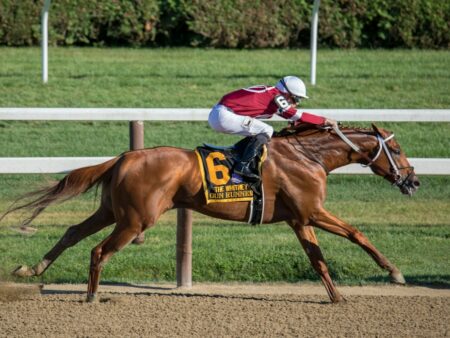

Imagine three horses lining up in the same race, and you don’t want to put all your money behind just one of them. You like three runners, not one — but betting the same amount on each means a very different profit depending on which one actually crosses the line first. That uneven outcome is exactly the problem dutching is built to solve.
What Dutching Actually Means
Dutching is a staking method that spreads a total stake across several selections in the same market, with each individual stake sized so that the profit is the same no matter which of your chosen selections wins. Wikipedia’s entry on dutching defines it as a method of sharing the risk of losing across a number of runners by backing more than one selection and calculating the correct stake on each so the return is identical regardless of which one comes in.
It works on any market with more than two realistic outcomes — horse racing fields, golf tournaments, outright winner markets, futures — anywhere you’d rather back a shortlist than a single pick.
The Problem: Flat Stakes Don’t Give You Equal Profit
Say you like three selections at different odds and you stake the same amount on each. The one with the longest odds pays out far more than the one with the shortest odds if it wins — your actual profit swings wildly depending on which selection comes through, even though you rated them similarly. Flat staking across uneven odds means your result is partly down to which pick wins, not just whether one of them does.
Dutching removes that lottery-within-the-bet by sizing each stake in proportion to its odds, not splitting the budget evenly.

The Dutching Formula
The stake for each selection is calculated like this:
Individual stake = Total stake × (1 ÷ selection’s odds) ÷ Σ(1 ÷ odds of all selections)
In plain terms: convert every selection’s decimal odds into its implied probability share (1 ÷ odds), add those shares together, then give each selection a slice of the total stake proportional to its own share. Selections with shorter odds (more likely to win, by the market’s pricing) get a bigger slice of the stake; longer-odds selections get a smaller slice — because they’d pay out more per dollar if they hit.
A Worked Example
Three selections, decimal odds of 3.00, 4.00 and 6.00, total budget of $100.
- Implied shares: 1/3.00 = 0.333, 1/4.00 = 0.250, 1/6.00 = 0.167
- Sum of shares: 0.333 + 0.250 + 0.167 = 0.750
- Selection A stake: 100 × (0.333 ÷ 0.750) = $44.44
- Selection B stake: 100 × (0.250 ÷ 0.750) = $33.33
- Selection C stake: 100 × (0.167 ÷ 0.750) = $22.22
Check the result: if A wins, $44.44 × 3.00 = $133.33 back, for a profit of $33.33. If B wins, $33.33 × 4.00 = $133.33 back, same $33.33 profit. If C wins, $22.22 × 6.00 = $133.33 back, again $33.33 profit. Whichever of the three wins, the outcome is identical — that’s the entire point of the calculation. Running your own numbers by hand each time is doable but fiddly; the Dutching Calculator does this split automatically once you enter your odds and total stake.
Dutching vs. Surebets (Arbitrage): Not the Same Thing
Dutching is often confused with arbitrage betting, but the two work on different logic. Dutching backs several selections within a single market at a single bookmaker, and only pays off if one of your chosen selections wins — if the field’s winner is outside your shortlist, the whole stake is lost. Our arbitrage betting guide covers the different approach: backing every realistic outcome of an event, usually split across multiple bookmakers offering mismatched prices, aiming for a profit that’s locked in regardless of the result. Arbitrage, when it genuinely exists, removes outcome risk entirely; dutching reduces outcome risk by narrowing it to “did one of my picks win” rather than “did my one pick win,” but the risk of losing the full stake never disappears.
Dutching vs. Double Chance: Different Mechanics, Similar Instinct
Double chance betting and dutching both let you cover more than one result, which is why the two get grouped together — but they’re priced completely differently. A double chance bet (1X, X2 or 12, as explained in our double chance betting guide) is a single bet at a single combined price set by the bookmaker, usually limited to two outcomes in a three-way market like football’s win/draw/win. Dutching, by contrast, lets you choose any number of selections across any market, and you calculate the individual stakes yourself from each selection’s own odds rather than accepting one bookmaker-set combined price. Double chance is simpler and has no calculation to do; dutching is more flexible but requires the stake-splitting math (or a calculator) to get the proportions right.

Dutching Doesn’t Remove Risk From Your Bankroll
Spreading a stake across several selections does not create a guaranteed profit — it only guarantees that profit is equal across the selections you backed, provided one of them wins. If none of your chosen selections comes through, the entire stake set aside for that dutch is lost, exactly as it would be on a single losing bet. Because a dutch commits more of your total budget per event than backing one pick, it’s worth sizing each dutch against your overall bankroll rather than your usual single-bet unit — our bankroll management guide covers unit sizing in more detail.
Frequently Asked Questions
Is dutching the same as arbitrage betting?
No. Dutching backs several selections in the same market and only pays off if one of them wins, so it still carries the risk of losing the full stake. Arbitrage aims to cover every outcome of an event, typically across different bookmakers, to try to lock in a profit regardless of the result.
Can you lose money with dutching?
Yes. If the outcome that actually wins isn’t one of your selected picks, the whole stake set aside for that dutch is lost, just as with any ordinary bet.
Does dutching guarantee a profit?
No. It only equalizes the profit across the selections you’ve chosen if one of them wins — it does not guarantee that one of them will.
Can dutching be used with just two selections?
Yes, dutching works with any number of selections from two upwards. With only two picks it can look similar to a double chance bet, but the stakes are still calculated from each selection’s individual odds rather than accepted as a single combined price.
George Mahulet has covered African sports betting and iGaming markets for over six years, focusing on how licensing, mobile money integration, and bonus terms actually play out for bettors in Nigeria, Kenya, Tanzania, and South Africa. Before joining Best10Betting, he worked as a data analyst for a Lagos-based fintech tracking mobile payment adoption — experience that shapes his focus on the payment and licensing details other betting content tends to skip. He verifies every bookmaker’s regulatory status directly against the relevant national gaming board before publishing a review, and updates existing reviews whenever bonus terms or licensing status change rather than leaving them static after launch.